Future and strategy
Ten years to abundance? Key takeaways from Elon Musk’s interview with The Economist
You do not have to believe that money will lose its importance by 2036 to take the direction seriously. Musk’s optimistic end state almost overshadows the most important sentence in the interview: the road there may be bumpy.
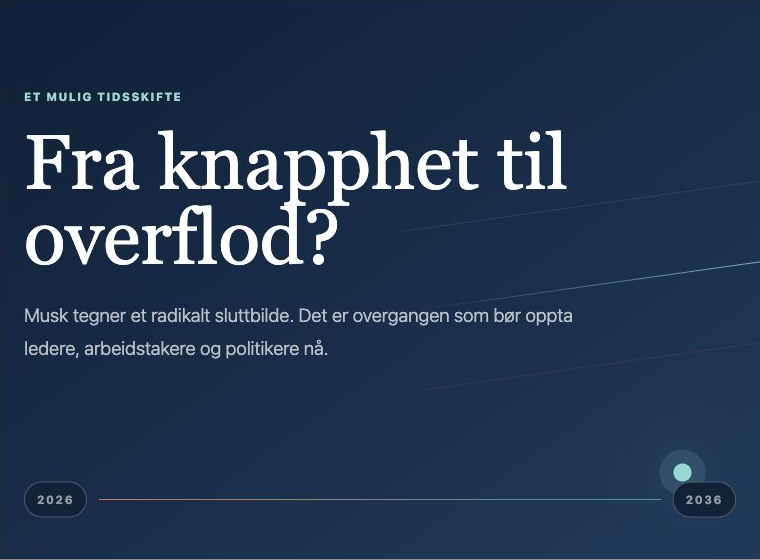
Musk paints a radical end state. The transition is what leaders, employees and policymakers should focus on now.
The Economist’s editor-in-chief, Zanny Minton Beddoes, gets something right from the start: she lets Elon Musk describe the future in his own words, then follows the optimism all the way to the difficult questions of work, income, ownership and power.
In brief
- Musk believes AI and robots could create an almost unlimited supply of goods and services within roughly ten years.
- He imagines work becoming optional and “universal high income” replacing today’s link between jobs and income.
- At the same time, he says the transition will be bumpy. This is the period organisations and societies need to start preparing for.
 Watch the full interviewElon Musk meets The Economist
An unusually optimistic end state
Musk believes digital intelligence will first take over a growing number of tasks performed on a screen. It will then connect to humanoid robots capable of producing goods and delivering physical services. When both digital and physical work can scale, he believes the economy may become so productive that scarcity loses much of the significance it has today.
This is not a cautious productivity forecast. It is a claim about a different economic system: work becomes more like gardening – something we may choose because it is meaningful – while a universal high income provides the means to live.
“The most likely outcome is an age of amazing abundance.”
Elon Musk · The Economist
“Money won’t matter in 2036.”
Elon Musk · The Economist
“I mean it will be a bumpy road.”
Elon Musk · The Economist
The most important caveat
It is easy to focus on the promise of abundance. But abundance – if it arrives – is not just around the corner. First comes a period in which technological capabilities may develop faster than labour markets, organisations and institutions can adapt.
Musk uses earlier waves of automation as a comparison. Jobs have disappeared before, and new ones have emerged. The difference he highlights is the pace. AI can affect many digital occupations at once, while robotics gradually moves the change into the physical economy.
This is where the interview becomes relevant to Norwegian organisations. We do not have to agree on 2036, nor believe in frictionless abundance. But if even a moderate part of the direction is right, it is risky to wait for certainty before building capability, improving workflows and learning how to organise the interaction between people and machines.
You do not have to believe the timeline to take the direction seriously.
The response: vision or wishful thinking?
Reactions have been about as divided as one might expect. Some read the interview as a remarkably clear picture of where AI and robotics could take us. Others dismiss it as technological optimism without credible answers on energy, resources, ownership and distribution.
The direction matters more than the date
AI and robotics could deliver a dramatic productivity boost even if money, work and scarcity do not disappear by 2036.
Abundance does not solve distribution
Several critics point out that technology does not automatically distribute ownership, income, energy or scarce natural resources.
The transition is the real issue
The most actionable issue is not the utopia, but how we manage transformation, concentration of power and different rates of change.
Vinod Khosla has warned that an age of abundance could also become dystopian if power and value creation are concentrated. TechRadar was much harsher, calling the vision wishful thinking that ignores basic economics and resource constraints. The two reactions show why the interview is interesting: the opportunities are enormous, but the political and economic mechanisms are far from resolved.
A small challenge to today’s debate
Perhaps the most surprising point is how little space scenarios like this still receive in mainstream politics and public planning. We readily project labour needs all the way to 2050 as if occupations, productivity and organisation will develop relatively smoothly.
Such projections can be useful, but they provide a weak basis for decisions if treated as the only likely future. A 2050 forecast that mainly extends today’s working life may be neat. It is not necessarily forward-looking.
Politicians and the public can be forgiven for focusing more on the next budget, interest-rate change or election. But when serious technology communities discuss whether large parts of knowledge work may change within two to ten years, it deserves more than a passing glance in economic policy.
On the political part of the interview
The final section becomes a much sharper discussion about Europe, the media and Musk’s political involvement. It is interesting, but not the main subject here. Both Musk and Minton Beddoes argue from values they believe protect society, while holding very different views of the path ahead. Their disagreement should not overshadow the longer-term discussion about AI, work and value creation.
What should organisations do now?
Do not try to plan 2036 in detail. Plan to learn faster over the next 12 months. Find workflows with clear friction. Build experience with AI through real tasks. Ensure sound sources, ownership and control. Measure whether the work actually improves.
There is also no reason to automate chaos. The best start is often small: one workflow, one clear problem and a solution that can be evaluated. This builds both value and capacity for change, regardless of whether Musk gets the year right.
If abundance arrives, we will have plenty of time to discuss what work should mean when it becomes optional. First we have to travel the bumpy road there.
Sources and further reading
- The Intelligence from The Economist – official episode description and audio version, 23 July 2026.
- The Economist on YouTube – the video linked in the article.
- The Economist Insider – the full version from the publisher; a subscription may be required.
- Elon Musk Archive – unofficial transcript used to verify wording and the placement of quotations.
- Fortune – on the response and Vinod Khosla’s warning.
- TechRadar – a strongly critical perspective on the abundance vision.