
Adoption and value
AI use is accelerating. Where is the business value?
Norwegian employees and organisations are adopting AI quickly. Yet much of the impact stops at individual time savings, better quality and promising pilots. Value becomes organisational only when the organisation changes the work itself.
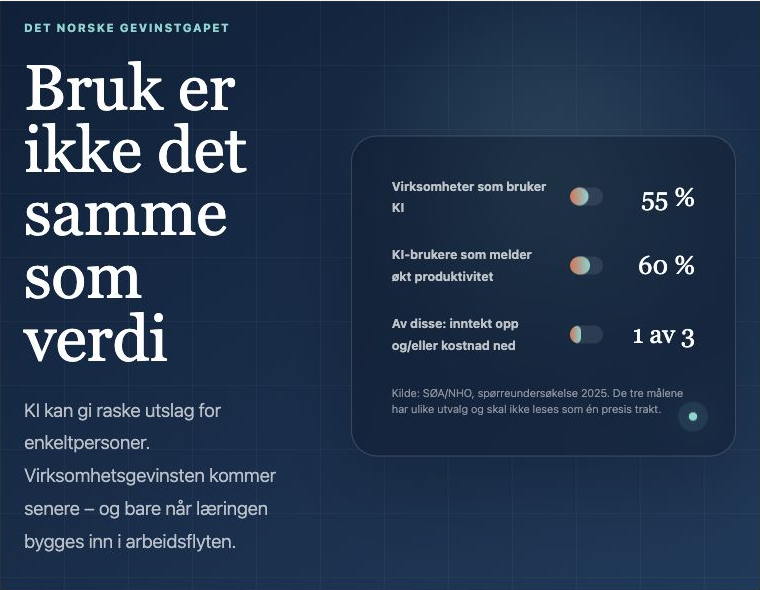
AI can deliver rapid benefits for individuals. Organisational value comes later – and only when learning is built into the workflow.
Source: SØA/NHO, 2025 survey. The three measures use different samples and should not be read as a single precise funnel.
It has become much easier to buy a licence, open a conversation and get help from AI. It is still difficult to turn the time saved into better services, higher revenue or lower costs across the organisation.
In brief
- AI adoption is growing quickly, but use remains poorly integrated into work processes across large parts of Norwegian business.
- Individual benefits come first. When old goals, roles and ways of working remain, much of the value stays with the individual.
- The most successful organisations prioritise specific workflows, establish clear leadership ownership, build capability through the work and measure results.
The adoption is real
In a survey conducted by Samfunnsøkonomisk Analyse for NHO, 55 per cent of Norwegian organisations said they used AI in 2025, up from 24 per cent in 2023. Official statistics from Statistics Norway also show that three in ten enterprises with at least ten employees used one or more AI technologies in 2025. The figures do not measure exactly the same thing, but they point in the same direction: use is increasing rapidly.
The large majority have nevertheless not reached scaled transformation. SØA/NHO classifies 19 per cent as frontrunners and 17 per cent as advanced users. More than half are still explorers. AI is being tested, but it has rarely become a systematic part of how work actually flows.
The percentages come from different surveys and populations. They show the pattern but should not be compared as one continuous data series.
Individuals feel the benefit first
It is logical that personal benefits arrive before organisational ones. An employee can produce a better first draft, analyse faster or save an hour in the very first week. In Microsoft’s global 2026 Work Trend Index, 66 per cent of AI users say they have more time for high-value work, and 58 per cent say they produce work they could not have delivered a year earlier.
But time saved does not automatically mean costs saved. McKinsey’s research shows that the time often goes to new tasks or more of the work the employee already had. For the individual, the result may be better quality, less backlog or a slightly calmer working day. All of this has value. It simply does not necessarily appear in the accounts.
“In many cases, people are ready. The systems around them are not.”
Microsoft Work Trend Index 2026
This is the value gap: the employee changes practice while the organisation continues to plan, measure, staff and reward as before. Microsoft finds that culture, leadership support and people practices have more than twice the correlation with reported AI impact as individual effort alone.
The technology can be adopted in a day. A new way of working must be learned, embedded and governed.
What distinguishes those who succeed?
The most consistent finding across Norwegian and international studies is not a particular model or platform. It is that the winners approach implementation differently. McKinsey finds that organisations with the greatest documented impact are almost three times as likely to have redesigned workflows. They also have clearer leadership ownership and are more likely to scale what works.
They choose a specific workflow
They start with friction, quality and the desired outcome – not a general search for use cases for a new tool.
They make change part of the job
Leaders demonstrate the desired practice, set aside time for experimentation and share what the team learns. Champions are not left on their own.
They measure before and after
Time, quality, customer value and risk receive a baseline. Someone owns the value, and human oversight is built in where the consequences require it.
SØA/NHO finds the same pattern in Norway: frontrunners report the greatest productivity effects, and value arises primarily when AI is integrated into work processes – not when the technology is merely tested or used inconsistently.
What is holding Norwegian organisations back?
The most common barriers are less dramatic than the debate may suggest. Among organisations that do not use AI, the main issues are a lack of insight into which problems the technology can solve, uncertainty about benefits, and insufficient capability to understand, test and use it. As organisations mature, concern shifts towards data security, privacy and regulation.
Time is a real part of the explanation. Most people still have to serve customers, invoice, manage operations and keep the working day on track. Transformation competes with today’s production. That makes leadership prioritisation decisive: without allocated time, learning becomes a spare-time activity for the most interested employees.
Are trade unions and “Norwegian comfort” the main problem?
There is little evidence for treating trade unions as a primary barrier. Organisational resistance exists, but Norwegian studies rank limited understanding of value, capability gaps and uncertainty higher. The Norwegian Confederation of Trade Unions highlights both the opportunities for efficiency and the need for employee participation. Norway’s tradition of labour–management cooperation can therefore become an advantage if employees are involved early – and a brake if change is perceived as covert monitoring or one-sided downsizing. A safe and well-functioning working life may reduce the sense of crisis, but that is a reasonable hypothesis rather than a documented main finding in the studies.
Is the public sector in the lead?
The answer is both yes and no. The public sector has scale, data, strong professional communities and considerable capacity to build frameworks. Well over half of public-sector organisations now report using AI, and many report faster task completion, freed-up time and better quality. The OECD also notes that Norway has established a strategy, governance and a broad portfolio of use cases.
But documented value also lags here. Digdir shows that only one in four public-sector organisations has converted efficiency gains into reduced costs or resource use. The Office of the Auditor General of Norway has also identified shortcomings in coordination, data, infrastructure, legal clarification and capability. The public sector is therefore sometimes ahead in experimentation and responsible frameworks – but not necessarily in realising value.
It is good that the public sector leads where trust, language, shared infrastructure and essential public services are at stake. But it should also be a demanding first customer for Norwegian technology companies. The government’s own AI strategy recognises that young, innovative companies often struggle to win public contracts. A state that develops everything itself may end up weakening the market it wants to build.
From individual benefit to organisational value
Every transformation requires effort, and AI is no exception. Personal returns can appear within days or weeks. Organisational returns normally take longer because capability, processes, data, accountability and measurement must work together.
This does not mean the organisation should wait for a perfect strategy. It should start smaller and more specifically.
- Choose one workflow with clear friction.Describe current time use, quality, waiting, errors and control requirements before choosing a solution.
- Give the value an owner.Someone must be accountable for the outcome, the change in ways of working and how released capacity will be used.
- Build capability through real work.Short courses are useful, but learning sticks when the team uses AI on its own tasks, sources and decisions.
- Test simply and measure soon.A first version should generate learning. Compare it with the baseline and decide whether to improve, scale or stop.
- Make the learning an organisational asset.Document effective ways of working, quality requirements, roles and controls. The value then becomes more than a private benefit for a few champions.
This is also at the heart of Naviqon’s approach: start with the work. Develop leadership, capability and technology around a prioritised workflow. Measure what matters and build on what the organisation actually learns.
Sources and further reading
- Samfunnsøkonomisk Analyse / NHO: Use of artificial intelligence in Norwegian business, report 1-2026 based on the 2025 survey.
- Statistics Norway: Use of AI has accelerated over the past year, official statistics for enterprises with at least ten employees.
- Digdir / IT in Practice 2025, on use and value realisation in the public sector.
- Microsoft Work Trend Index 2026, global survey of 20,000 AI users and analysis of Microsoft 365 signals.
- McKinsey: The State of AI 2025, on value, scaling, leadership ownership and workflow redesign.
- OECD: Artificial intelligence in Norway’s public sector, on progress, governance and remaining challenges.
- Norwegian White Paper 14 (2024–2025), including the Office of the Auditor General’s assessment of government AI work.
- Norwegian Confederation of Trade Unions: Artificial intelligence and working life, on opportunities, employee participation and a fair transition.